A few years ago I saw a movie about Japanese monkeys. In cold weather, they would come down from the mountain forests to the hot springs and sit in them all day long. I remember how I couldn’t tear myself away from the screen. And when we were about to go to Japan, snow monkeys were the first thing that came to mind. That’s why Jigokudani Park was an obligatory stop on our itinerary.
Download: Detailed Itinerary: Japan in 2 Weeks + Budget

How to get to the snow monkeys without a car
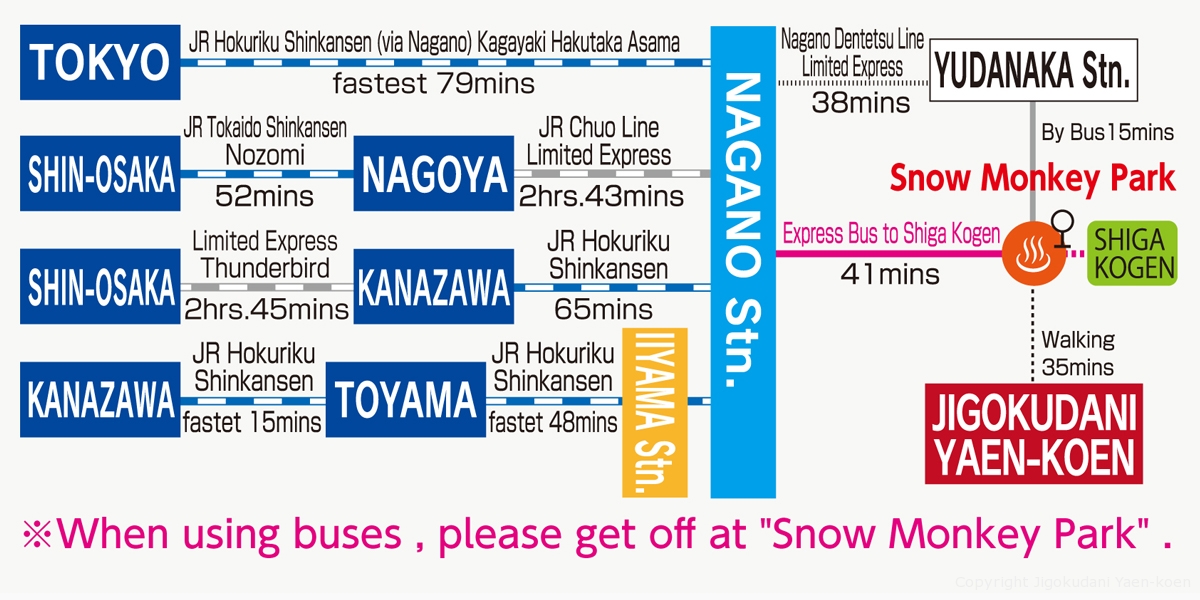
To Jigokudani Park by train from Tokyo
Jigokudani Snow Monkey Park is located in the Yokoyu River Valley of Nagano Prefecture, a few hours’ drive from Tokyo. To get there without a car you have to take several trains, buses and walk 1.6 kilometers through the woods on a narrow path.
We got up early on the Hokuriku shinkansen to Nagano (departs at 7:20 am from Tokyo Station) with one change on the monkey-express to Yudanaka (the terminus closest stop to Jigokudani). The trip from Tokyo to Yudanaka took 2.5 hours.
Local trains and express trains from Nagano Station to Yudanaka are not covered by JR Pass, you have to buy and pay separately at the station – about 1300 yen (≈10 USD). You can also buy a Snow Monkey Pass for 2 days, which includes all transportation from Nagano + park admission. Read more here.
There were buses waiting right outside the station to the Jigokudani trailhead. We bought tickets inside, 310 yen/person(≈2.4 USD). We drove about 15-20 minutes.


Jigokudani Park by train from other Japanese cities
Osaka: On Tokaido shinkansen to Nagoya. Change to Chuo Main Line Express to Nagano (about 3 hours). Express bus nagaden to Shiga Kogen, the beginning of the trail. 1500 yen/person(≈12USD) cash.
Kanazawa: Hokuriku shinkansen to Toyama, change to Iiyama station, express bus to the trailhead to Jigokudani Park (34 min).
Other detailed itineraries can be found here.
READ MORE: Kanazawa in 1 Day
Trail to Jigokudani Park
The bus brought us to the trailhead. Next to the entrance there is a cafe, a restroom (only here, no further in the park itself!) and an information point (where you can leave suitcases, rent clothes and ask questions).
The road through the woods to the park entrance was easy, but muddy. Sometimes snow fell from the branches of the trees. On the slopes we met wild Japanese serow goats. They were not afraid of people and looked at everyone with interest.


After about 20-25 minutes, the houses of the old hotel and the first bubbling hot springs appeared. It wasn’t much further to the park entrance. On average, the route from the bus stop to the monkeys takes 30 minutes. We did it a little faster.

Jigokudani Snow Monkey Park
There is a fee to enter Jigokudani Park. An adult ticket costs ¥800 (≈7.4 USD), a children’s ticket ¥400 (≈3.7 USD). We paid and went inside.
At first I saw moving animals in the distance. Then I heard people screaming with excitement. And then… A pack of monkeys rushed by and almost knocked me down. Monkeys were everywhere! They were walking in the crowd, posing for the cameras and chewing something. The locals feed them so as not to disappoint tourists.


And everything would be great, but… The famous Japanese Monkeys, stars of movies and magazines, showed no interest at all in the huge hot tub where they should be sitting and enjoying themselves. Not ten minutes later, not even half an hour later, not one of the 150 macaques ever got into the onsen! We waited as long as we could.

We threw one last sigh at the monkeys and headed back. Buses often run from the park parking lot and there are even special guides to prompt you with stops and schedules.
Overall, Jigokudani did not disappoint. It was interesting to come all this way and see the snow monkeys for real, even if not in the hot springs.
When to go to the Snow Monkey Park
The snow monkeys bath in the onsens only during cold weather, from December to February. We were in the park in early March and the snow monkeys never got in the water. They just wandered around.
If you want to see animals in the hot springs, go to Japan in the deep and cold winter. However, during heavy snowfalls the trail to the park becomes unsafe and sometimes is closed. Be sure to check the news on the website before you go, and the fluffies on the live camera at the same time.
Dress for the weather! In the winter, the Info booth at the trail entrance rents boots and clothes. You can also leave items there for ¥500.
Useful Information
- The monkeys in the park are wild. For your safety it is better not to touch or feed them
- There are no toilets in the park, only at the trailhead
- Selfie sticks and drones are prohibited in the park
- The park is open all year round: Apr-Oct from 8:30 to 17; Nov-Mar from 9 to 16.
- Wear comfortable shoes, High heels in the mud are not an option.
- Don’t eat in front of monkeys! If you’re hungry, wait until you get out of the park
READ MORE: 27 Ways to Save Money in Japan