Victoria is the charming capital of British Columbia and, perhaps, one of the most “English” cities in Canada. Double-decker buses roll through its streets, Victorian-era houses stand alongside real castles, and traditional afternoon tea has long become one of the city’s signature tourist experiences.
Victoria is definitely not a one-day city. You can easily spend a full weekend here and still feel like you’ve missed something: a walk along the waterfront, gardens and museums, local restaurants, a drive to the ocean, and that slow, easygoing island atmosphere. Below, I’ve put together the most interesting, beautiful, and delicious places in Victoria to add to your itinerary.
How to effectively plan a trip around the Island (and Victoria among others) check out here.

Where to stay
There are plenty of great places to stay in Victoria. Here are a few interesting options that are conveniently located and offer excellent value for the price:
The Fairmont Empress Hotel is a beautiful, historic hotel right in the heart of the city. It’s a local landmark, and staying here is an experience in itself. Pets are welcome.
The Inn at Laurel Point is a stylish hotel with great views. It’s an excellent choice if you’re looking for a beautiful, quiet place in a great location. There’s a delicious café and restaurant on the ground floor.
The Oswego Hotel is one of my favorite hotels. It has spacious, pet-friendly rooms with kitchens. There’s an excellent restaurant on the ground floor. Residents of British Columbia and Alberta get a 20% discount when booking on the official website.
The Westin Bear Mountain Golf Resort & Spa —a spa and golf resort located a 30-minute drive from downtown Victoria. For those looking to escape the hustle and bustle of the city.
Oak Bay Beach Hotel —a five-star hotel on the coast. It features a spa, a pool with views, and pet-friendly rooms.
Rosemead House is one of the most beautiful hotels in Victoria—perfect for a romantic getaway.
SookePoint Ocean Cottage Resort —new apartments in Sooke with ocean views. There’s a beautiful trail nearby.
The Vic is a decent pet-friendly option with a kitchen if you’re looking for something more affordable.
Things to do
The Butchart Gardens
One of Vancouver Island’s main attractions is Butchart Gardens.n 2004, they were designated a National Historic Site of Canada. Open to visitors year-round, the gardens are always in bloom – with around 900 different varieties of plants!

Butchart Gardens owes its creation and incredible success to Jennie Butchart. More than 100 years ago, she moved from Ontario to Vancouver Island with her husband. The family purchased a rich limestone deposit and entered the cement business.
When the limestone deposits in the quarry were depleted, Jennie decided to turn the industrial pit into a blooming garden. It was filled with soil and planted with trees, flowers, and ornamental plants. The Butcharts travelled widely and brought back ideas from different countries, so over time, the Italian Garden, Japanese Garden, magnificent Rose Garden, and other themed areas were created here.


The Butcharts named their estate “Benvenuto”—Italian for “welcome.” The gates to their garden were open to all visitors completely free of charge. By the 1920s, about 50,000 people had visited the Butchart Gardens. Today, Butchart Gardens welcomes about one million visitors annually. The park is still owned and operated by the Butchart family.
The grounds feature a large free parking lot, several cafes and restaurants, delicious ice cream, a gift shop selling seeds of local plants and flowers, and the famous Rose Carousel. Strollers and dogs on a leash are welcome.


My favorite time to visit Butchart Gardens is the second half of April and May, when the cherry blossoms, tulips, and wisteria are in bloom. It’s also beautiful in early June. If you want to avoid the crowds, plan your visit two to two-and-a-half hours before closing time or early in the morning.
Not far from the Butchart Gardens is an interesting Butterfly Garden. On your way to Victoria, stop by the Mediterranean restaurant Med Grill Royal Oak, which has a cozy terrace.

Parliament (Legislative Assembly)
A little over a hundred years ago, the British Empire was one of the largest and most influential empires in human history. Its territories stretched across the globe, covering nearly a quarter of the Earth’s land and encompassing around a quarter of the world’s population.
Canada, too, was part of that empire for a long time, and to this day the British monarch remains the country’s formal head of state. So don’t be surprised that on Vancouver Island, an entire ocean away from London, you’ll find such a stately and very “British” parliament building.

In 1892, Victoria held an architectural competition for the design of the Parliament Buildings. Among 65 submissions from across North America, the winning proposal came from Francis Rattenbury, a 25-year-old English architect who had only recently moved to Canada. It was his first major commission. According to local stories, Rattenbury concealed his age when submitting the proposal and signed his drawings with the pseudonym “A B.C. Architect.”
Construction took five years and significantly exceeded the initial budget, but the result was impressive. Following this success, Rattenbury designed several more iconic buildings that are now considered landmarks of British Columbia, such as the Fairmont Empress Hotel and the Court Building in Vancouver (now the Vancouver Art Gallery).


Admission to the Parliament building is free. On weekdays, the building is open for self-guided tours from 8:30 a.m. to 4:30 p.m., except on holidays. A free guide to the building is available for download online.
The Parliament also offers free guided tours. They usually last about 45 minutes, and it’s best to check the schedule in advance on the official website—there are more tours during peak season. On weekends, it’s best to arrive for the first tour and book your preferred time slot before the crowds arrive.
My favorite spot is the Parliamentary Dining Room—a dining hall where you can have breakfast or lunch. The entrance for visitors is to the right of the main staircase, through the Mowat Entrance. You’ll need to reserve a table in advance on OpenTable or by calling 250-387-3959. Check the official website for the menu. Be sure to bring a form of ID with you. After your meal, you can take a tour of the main Parliament building.
Every evening, thousands of energy-efficient lights illuminate the Parliament Buildings. For free two-hour parking — longer on weekends — look for a spot on Pendray Street.


Royal BC Museum
The Royal British Columbia Museum is one of the best museums I’ve had the chance to visit in Canada. It’s a real treasure trove, and you should set aside at least two hours to explore it.
The Royal BC Museum’s collection contains more than 7 million artifacts, natural specimens, and archival records. In fact, museum staff have even compiled a list of the 100 most interesting items in the collection to help visitors find the highlights more easily.

The museum’s natural history galleries are especially impressive, with realistic dioramas showing animals in their natural habitats, the forests of British Columbia, coastal landscapes, glacial scenery, and the famous life-sized woolly mammoth nicknamed Woolly.
The exhibition dedicated to the cultures and languages of British Columbia’s Indigenous Peoples is also well worth a visit. The museum is home to an extensive collection of totem poles and cultural artifacts. In the Our Living Languages gallery, visitors can hear 34 Indigenous languages from across the province.
READ MORE: Vancouver’s Indigenous Peoples: 15 Places to Explore Local Culture


In the museum’s historic halls, you can literally “take a stroll” through British Columbia’s past: step aboard Captain George Vancouver’s 18th-century ship, see a full-scale fish-processing plant, and explore life-size recreations of 19th- and 20th-century Victoria streets. You can go inside some of the buildings, and in some places, you can even watch an old Charlie Chaplin movie.
IMAX Victoria 4K is located in the same building. If you’re planning to combine a museum visit with a movie, get a combo ticket.


Miniature World Museum
Your kids will love this museum — and, most likely, so will you. Miniature World features more than 85 tiny displays spread throughout its galleries, from important moments in Canadian history and magical scenes inspired by beloved books to miniature cities, railways, and even the world’s smallest working sawmill, which took 11 years to build.
Everything is so realistic and created with such attention to detail that you can easily spend a long time at each display, studying the tiny houses, miniature figures, moving trains, lighting, and little scenes from another era.


The museum is located inside The Empress, perhaps the most famous hotel in British Columbia. Opened in 1908, it quickly became one of Victoria’s most recognizable landmarks and has welcomed several members of the royal family, celebrities, and prominent political guests over the years.
Fun fact: In the summer, The Empress serves traditional English afternoon tea to more guests than many hotels in London. The tradition of afternoon tea has been a part of the hotel since it opened in 1908, and today it is one of Victoria’s most popular “British” attractions.
READ MORE: Vancouver’s traditional Afternoon Tea


Government House
I suggest trying some traditional English tea in a place you wouldn’t expect in Victoria—the Government House. Or rather, not even in the building itself, but in a small museum on the grounds.
Government House is the ceremonial residence and official residence of the Lieutenant Governor of British Columbia. The Lieutenant Governor is the representative of the British monarch in British Columbia.
You can see the building itself on a free tour, but space is limited, so you need to register for the tours in advance.

The grounds and gardens of Government House are open for everyone to explore. From the hill, you’ll get beautiful views of Victoria, the mountains, and the strait.


In the southeastern part of the estate, inside former 19th-century service buildings, you’ll find Cary Castle Mews — a small museum complex that is free to visit. Here, you can learn more about the history of Government House, see historic carriages, stables, and service rooms. Around 30 minutes is usually enough for a visit.


This is also where you’ll find Rudi’s Tea Room, a small and cozy tearoom with a wonderfully atmospheric setting. It’s worth stopping by for a traditional afternoon tea, with sandwiches, fresh baked goods, desserts, and tea served at a surprisingly reasonable price for Victoria.

Chinatown and Fan-Tan Alley
Victoria is home to Canada’s oldest surviving Chinatown, whose history dates back to 1858, during the Fraser River Gold Rush.
Today, the neighborhood is quite small, but historically it played a huge role: until the early 20th century, Victoria was one of the main centers of the Chinese community in Canada. According to the 2021 census, approximately 92,000 people live in the city of Victoria itself, and residents of Chinese descent make up about 3–4% of the population.


Here, you’ll find dragons, Chinese lanterns, the colourful Gate of Harmonious Interest, and the narrowest street in Canada. Fan Tan Alley is only about one to two metres wide — three people can barely pass through at once.
The alley takes its name from Fan-Tan, a Chinese gambling game similar to roulette. In its more notorious past, this area was home to gambling houses and opium dens, which were banned and closed more than a century ago. Today, Fan Tan Alley is a clean, charming, and very tourist-friendly little street lined with quirky shops, studios, and workshops.


Grab a coffee at Habit Coffee or Hey Happy—two of the city’s best coffee shops. Stop by Market Square and nearby Johnson Street—with their colorful historic houses, small shops, cafes, and local brands. Don’t miss the beautiful Zingaro Floral Perfumery, a shop full of all sorts of goodies.


Fisherman’s Wharf
One of Victoria’s interesting spots is Fisherman’s Wharf: a small pier lined with houseboats, fishing boats, and seafood cafes.
There are a total of 33 houses in the harbor. Everyone has access to drinking water, sewage, and electricity. The population of the fishing pier is about 50 people. Mostly single people and couples from 30 to 70 years old. Recently, old-timers have been selling their homes and moving on land, away from tourists.


At the pier, you can sometimes buy fresh catches straight off the boats: crabs, shrimp, salmon, and other local delicacies. You can take the seafood to go, or grab a bite to eat by the water at one of the cafes. My favorite is The Fish Store. Try their oysters, chowder, scallops, and fish sandwiches. At lunchtime, Fisherman’s Wharf is crowded with tourists and long lines. It’s better to come here for dinner.


Whale watching tours
Victoria is considered one of the best places in British Columbia for whale watching (along with Tofino). Whale-watching tours depart from here, with the chance to see orcas, sea lions, seals, and seabirds. The whale-watching season typically runs from May to October. In summer and early fall, the chances of spotting humpback whales are especially high, as they come close to shore to feed on krill and small fish. In early spring, gray whales migrate past the area on their way from Mexico.
You can book a whale-watching tour here or here.
READ MORE:
- Itinerary: Vancouver and Vancouver Island in 2 weeks
- Tofino: Top things to do in the Canadian surf capital
- Whale Museum in Telegraph Cove

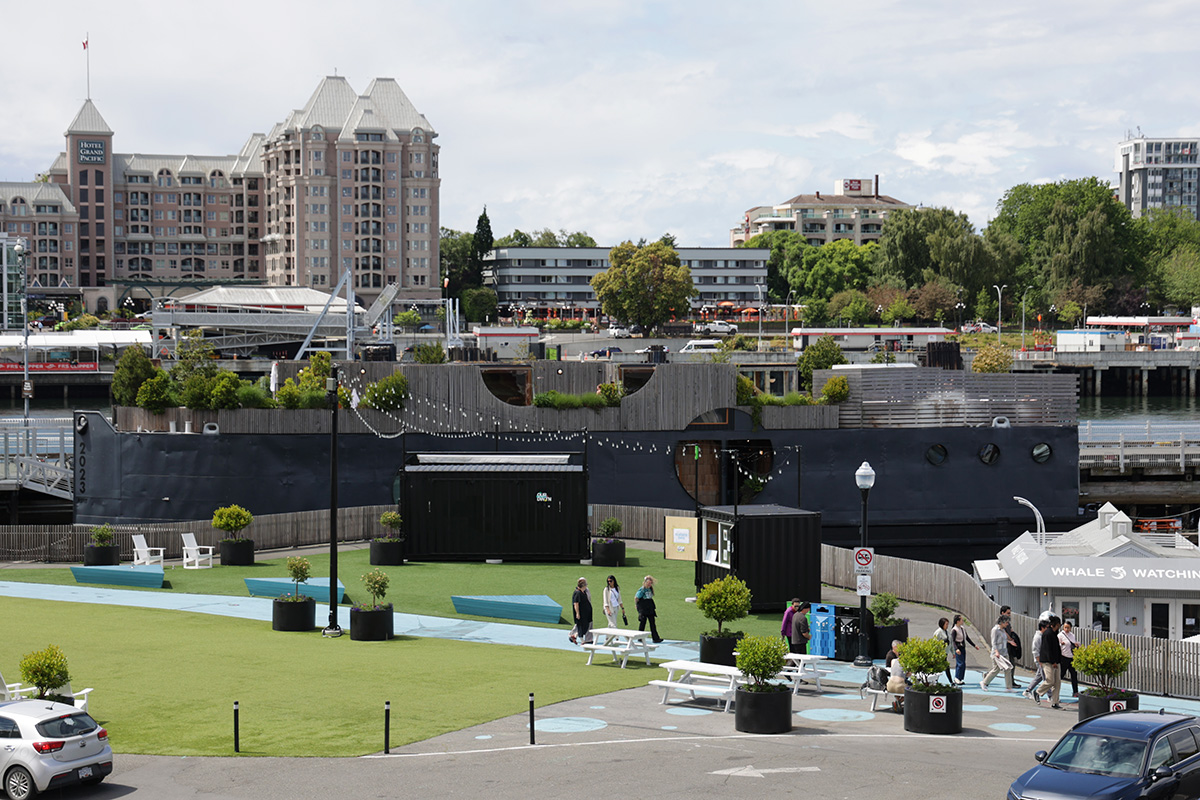
Floating Sauna (HAVN Saunas)
If you’re looking to relax while traveling, check out HAVN Saunas —a floating spa right in the heart of the city. An old barge has been transformed into a Scandinavian oasis of wellness and pleasure.
Inside, there are several saunas, cold plunge pools, hot tubs, relaxation areas, snacks, and drinks. The deck offers beautiful views of the harbor. It’s a very popular spot, so it’s best to make a reservation in advance.
Beacon Hill Park
Beacon Hill Park is a huge park in downtown Victoria and a great place to escape the heat, relax after a walk around the city, or have a picnic. It features well-maintained flower beds, tall trees, a pond, playgrounds, and a wooden stage where musicians often perform in the summer.
In the park, you can see squirrels, turtles, peacocks, and many kinds of birds. And if you’re traveling with children, be sure to stop by Beacon Hill Children’s Farm —it’s home to baby goats, piglets, and other farm animals.
Every spring, blue herons nest in Beacon Hill Park. Look for them in the trees and in the thickets near the pond.


Beacon Hill was once a burial site for the Indigenous Peoples of the island. One of the park’s most notable landmarks is the Story Pole, installed here in 1956. It was carved by a team led by the renowned artist Mungo Martin. Standing nearly 39 metres tall, it was considered one of the tallest totem poles in the world at the time of its installation.


On the outskirts of Beacon Hill Park, near the Mile 0 marker, the Trans-Canada Highway begins—a road more than 8,000 km long that crosses Canada from the Pacific to the Atlantic Ocean.
You’ll also find a monument to Terry Fox here, one of Canada’s most famous and beloved heroes. In 1980, after losing his leg to cancer, 21-year-old Terry began his Marathon of Hope: he set out to run across Canada to raise awareness and funds for cancer research. He managed to cover more than 5,000 kilometres. Today, his foundation has raised hundreds of millions of dollars and continues to support people across the country.

Well, what would Beacon Hill—“Lighthouse Hill”—be without a beautiful view? For one of the best panoramic views in the park, head to the flagpole flying the Canadian flag (Flagpole). From here, you can see the strait and the Olympic Mountains in the United States. There’s free parking nearby.
The park’s name comes from a small hill overlooking the strait, where navigational beacons once stood—the very “beacons” that helped ships find their way off the coast of Victoria.


Dallas Waterfront Trail
On the ocean side of Beacon Hill Park, you’ll find the Dallas Road Waterfront Trail, a scenic walking path that follows the coastline for about six kilometres. From here, you’ll get beautiful views of the Salish Sea and the snow-capped peaks of Olympic National Park in the United States.
Locals come here to walk their dogs, go for a run, ride their bikes, or simply enjoy the scenery. Along the most beautiful parts of the route, you’ll find viewpoints, benches, and access points down to the shore. There is plenty of free parking along Dallas Road.


Ogden Point Breakwater
For those who find a walk along the Dallas Road Waterfront Trail not enough, the route continues along the Ogden Point Breakwater. Its 762-meter promenade extends far out into the water, is closely patrolled by seagulls, and offers beautiful views in every direction. People prone to seasickness should be careful: in windy weather, the breakwater can get quite rocky.


The Ogden Point Breakwater was built in 1916 to protect the Port of Victoria from strong waves and winter storms. It was a massive project: over a million metric tons of stone were used for the foundation, and more than 10,000 granite blocks, each weighing up to 15 metric tons, were laid on top. In over a century of active use, only 136 of them have been replaced. That’s quality!
A fog signal and an electrical cable leading to the lighthouse have also been installed at Ogden Point. The lighthouse itself stands at the end of the breakwater, and the round-trip walk takes about 30 minutes.
Be sure to check out the colorful murals along the breakwater. Ogden Point was decorated with them in honor of the local Indigenous Peoples.
The name Ogden Point is derived from Peter Skin Ogden, a well-known fur trader, explorer, and employee of the Hudson’s Bay Company.


Craigdarroch Castle
Victoria is often called the most “English” city in Canada for a reason. In addition to double-decker buses, traditional afternoon tea, and the Parliament Buildings, the city is also home to two real castles. Both were built by and belonged to one of the wealthiest families in British Columbia — the Dunsmuirs.

In 1851, Robert Dunsmuir arrived on Vancouver Island from Scotland with his pregnant wife and children. In the early years, he worked as a coal miner under contract with the Hudson’s Bay Company, before trying his hand at various coal ventures.
Eighteen years later, luck was finally on Dunsmuir’s side. He discovered rich deposits of high-quality coal, invested all his savings into the venture — and made the right bet. The mine grew quickly, outpaced its competitors, and Dunsmuir gradually transformed from a hired coal miner into a coal magnate.
By the time the government offered him the contract to build the Esquimalt & Nanaimo Railway, Dunsmuir was already a successful industrialist. For the project, his company received a large cash payment and an enormous land grant — nearly 20% of Vancouver Island. This is how a Scottish immigrant became one of the wealthiest and most influential people in British Columbia.
At the height of his success, Dunsmuir decided to build a real castle for his family. Construction of Craigdarroch Castle began in 1887, on one of the highest and most beautiful sites in Victoria. Unfortunately, Robert himself did not live to see it completed: he died in 1889, one year before construction was finished.


Now that you know the story, stepping inside is a must. Expect lavish furniture, beautiful dresses once worn by his wife and daughters, a library, and absolutely stunning stained glass. In total, the castle has 39 rooms spread across about 2,300 square metres.
The name Craigdarroch translates from Scottish as “stony oak.” The exterior of the castle is clad in gray granite, while the interiors are finished in oak.


A few years after Robert Dunsmuir’s death, the castle was sold. Over the course of its history, the building has served as a military hospital, a college, a music conservatory, and a school board office.
Today, Craigdarroch Castle is owned by a private non-profit organization dedicated to its preservation and restoration. It’s best to arrive right when it opens.


Hatley Castle
The second castle, Hatley Castle, is located in nearby Colwood, about a 30-minute drive from downtown Victoria. It was built by James Dunsmuir, Robert Dunsmuir’s son, for himself and his wife. I absolutely love this place and try to stop by every time I’m in Victoria.
Even if you’ve never heard the name Hatley Castle, the castle itself will probably look familiar. It has appeared in several X-Men films, as well as Deadpool, Smallville, MacGyver, and other productions.

When James purchased the Hatley Park estate, he had already served as lieutenant governor, premier of the province, and was the heir to the wealthiest man in British Columbia. In other words, he could afford to spare no expense. No corners were cut on the new estate, and the castle was completed in record time — in just 18 months, in 1908.

Great attention was paid not only to the house itself, but also to the castle grounds. The estate included cow barns, stables, and magnificent gardens, maintained by more than 100 gardeners.
In 1910, James sold his share of the family coal business, resigned from public life, and retired. He spent his time fishing, golfing, and yachting. He and his wife lived at Hatley Castle for the rest of their lives.


In 1940, the estate was sold to the government. Now Hatley Castle is home to the Royal Road University.
The gardens and grounds are open to the public free of charge. Guided tours of the castle are offered on certain days. For more information, click the link.

Fort Rodd Hill and Fisgard Lighthouse
From Hatley Castle, take a drive to Fort Rodd Hill and Fisgard Lighthouse—the oldest lighthouse on Canada’s west coast. The lighthouse was built in 1859–1860 at the entrance to Esquimalt Harbour, even before the area became part of Canada.

The lighthouse was built by the British at the entrance to the harbour in 1860. Its 17-metre tower, incorporated into a rectangular keeper’s house, stands on a rocky islet and is incredibly photogenic. Before the lighthouse was automated, keepers lived here with their families; today, the building houses a small museum exhibition.
The lighthouse was named in honor of HMS Fisgard, a ship of the Royal Navy.


The causeway that visitors now use to reach the island was built in the mid-20th century. It was originally created to help protect Royal Canadian Navy ships from enemy torpedoes. A lucky addition, really — otherwise, today you’d have to row out to the lighthouse by boat.

The first batteries at Fort Rodd Hill were built in 1878. Barracks and other military structures were added and improved over the years, right up until the end of the Second World War. In 1956, the fort was officially declared obsolete. A little later, it was designated a National Historic Site of Canada and opened to the public.
Fort Rodd Hill was named after John Rushley Rodd, First Lieutenant of the ship HMS Fisgard.


The fortress is well preserved and consists entirely of original structures. Bunkers, barracks, gun batteries, command post, defensive walls. Plan enough time (1-2 hours) for local scenery, the Fisgard Lighthouse, and the old Fort. Check the official website for opening hours and days.


Esquimalt Lagoon
If you find yourself near Hatley Castle or Fort Rodd Hill late at night, don’t rush back to downtown! Take a drive along Ocean Boulevard—a small, narrow road in the middle of the Esquimalt Lagoon. It offers stunning views of the sunset.


The lagoon is home to various species of birds: herons, eagles, swans. But there are some that you meet only here.
Several years ago, an ex-convict put together a jay from wood and driftwood on the beach. People who passed by began to admire his work. The enthusiastic artist decided to go ahead and put on an entire exhibition along Ocean Boulevard. Today his birds are known and photographed by everyone who comes to the lagoon. The artist’s name is Paul Lewis.


Gonzales Hill Regional Park
Another hidden viewpoint is located in downtown Victoria: Gonzales Hill Regional Park. This small park offers a magnificent 360° panoramic view of the city, the Strait of Juan de Fuca, and Olympic Park. Deer roam freely, and there are almost no people around.


The white observatory building used to serve as a weather station. It is currently closed. On your way back, stop by Abkhazi Garden. They serve afternoon tea there, too.


Art Gallery of Greater Victoria
Victoria was the birthplace of one of Canada’s most famous artists, Emily Carr. Most of her works are kept at the Vancouver Art Gallery, but you can also see several of her pieces and writings in her hometown — Emily was also an author. The Art Gallery of Greater Victoria has dedicated an entire room to her work.
READ MORE: What to visit in Vancouver? Top 15: Best of the Best

It is also home to a rich collection of Asian art. The Large Chinese Ming Dynasty bell (1641), exquisite ivory and amber products, vases, porcelain and much more.


The Victoria Art Gallery was opened in a historic 1889 mansion. Later several modern galleries were added to it. In the courtyard is a Japanese garden with the only authentic Japanese Shinto shrine in North America.

Churches and Cathedrals of Victoria
Victoria has many beautiful churches and cathedrals. Most are located along Quadra Street. Here are a few of the most interesting ones.
St. Andrew’s Cathedral – Roman Catholic cathedral of 1892. It is famous for its acoustics (almost the best of any building in Western Canada). The organ is available for Sunday services at 9:30 and 11 a.m.


Christ Church Cathedral – An Anglican cathedral in the Gothic style of the 13th century. The seat of the Bishop of British Columbia and one of the largest churches in Canada. Organ concerts are held. This is the third version of the Cathedral of Christ, 1929. The first building (1856) burned down, the second (1872) did not match the size of the meetings and was rebuilt.

St. John the Divine AnglicanChurch is an Anglican church with an interesting history. It was given to the city by the English Baroness Angela Burdett-Coutts in 1860. The building was built in England, out of pieces of iron. Then they took it apart and sent it to Canada. “The Iron Church” was the first consecrated Anglican church in Victoria.
The land was later purchased by the Hudson’s Bay Company. The church was dismantled for $220 and a shopping center was built. The new brick and stone Church of St. John the Evangelist opened in 1912 at the intersection of Mason and Quadra Streets.
The history of this church was described in detail by Stuart Underhill, in his book The Iron Church.


Alix Goolden Performance Hall – An 800-seat performance hall in the former 1891 Methodist cathedral. The Victoria Conservatory of Music bought the building for 2 million dollars. Named after Alix (Wilson) Goulden, founder and patron of the conservatory. Click here for a poster of the performances.

Malahat SkyWalk
About a 35-minute drive from Victoria, you’ll find one of Vancouver Island’s newest and most unusual attractions — the Malahat SkyWalk.
First, you follow a 600-metre wooden walkway through dense forest, about 20 metres above the ground. Then the route leads you to a huge 10-storey spiral tower. Once you reach the top, the beauty — and the height — are enough to take your breath away. The viewpoint sits 250 metres above sea level.


You can slide down from the tower on a long spiral slide—it’s a fun activity for both children and adults.
The Malahat SkyWalk is a popular spot, so it can get crowded, especially in the summer and on weekends. Try to visit on a weekday and arrive early. It’s a really interesting place—I recommend adding it to your itinerary for Vancouver Island.
DOWNLOAD: Itinerary — Travel Guide: Vancouver and Vancouver Island in 2 Weeks


Niagara Falls
On the way from Victoria to the Malahat Tower, you will see a large parking lot on the right side of the highway. There will be a lot of cars and people there. This is Goldstream State Park, with scenic trails and Niagara Falls. Its narrow strip of water plummets from a height of almost 50 meters against a backdrop of green rocks!
It takes a few minutes to walk from the parking lot to the waterfall, to the left across the creek under the bridge.


East Sooke Regional Park
As a treat, I’ll tell you about my favorite park 35 kilometers from Victoria – East Sooke Regional Park. 50 kilometers of some of Vancouver Island’s most beautiful trails!

The Coast Trail is very popular. I walked through individual parts.
To BeechyHead— through a pine forest and over the cliffs, about 6 kilometers. It’s not the easiest hike, but it’s beautiful! On a sunny day, the water turns a bright blue. Seals splash about near the shore.


On this trail you will find a stone with an ancient petroglyph. Several similar Native artwork is scattered throughout the park. No one knows exactly how old they are (hundreds, thousands?). Under the influence of the weather, the petroglyphs gradually fade and disappear.
READ MORE: Petroglyph Park on Gabriola Island

The next interesting point is Beechy Head with a small white monument.
On the maps, the southwest boundary between the United States and Canada runs clearly along the 49th parallel and sticks out a bit near Vancouver Island, which is much farther south. In 1908 the countries signed a treaty that clearly defined the boundaries of the west coast. On the ground they were fixed with these white markers. The mountains opposite and half of the Salish Sea in the photo are already America.


The second trail to Iron Mine Bay and Pike Point went from the other side of the park. It’s shorter and simpler. I left the car at Ocean Park Pl, in front of the gate of Sooke Point Ocean Cottage Resort. On Google, the entrance is marked Silver Spray Trailhead. Before you go out, check to see if they’re letting you in the gate now. Check the other options on alltrails.


Delicious Restaurants and Cafes in Victoria
The Fish Store – a floating café at the Fishermen’s Wharf. Try their oysters, chowder, scallops, and fish sandwiches.
10 Acres Bistro – Great food and menu selection. Beautiful stylish green interior, lots of space. Brunches are especially good.


II Terrazzo – chic Italian restaurant for a romantic evening. Try pasta and seafood. Reserve a table in advance.
Good Earth Coffeehouse – Two locations in Victoria. Both are great options if you’re looking for a delicious quick breakfast with patio seating or just a light snack.
TORO Japanese Sushi – For japanese cuisine lovers.
Boom + Batten Restaurant & Cafe – A delicious restaurant on the waterfront with an interesting menu. Perfect for both a casual lunch and a special evening out.
Habit Coffee – In my opinion, they serve the best coffee in town here
Tacofino Victoria – The menu is just like at your favorite food truck in Tofino, but without the crazy lines.
Island Poké and Steve’s Poké Bar — for fans of delicious poke in Victoria.
iluka espresso – A peaceful, stylish spot for a delicious breakfast.
GoodSide Pastry House – one of the best bakeries in town. Come right when it opens—there’s always a line here.
READ MORE: Vancouver’s Top 10 Coffee Shops

How to get there?
Ferry
The ferry is the most common and relatively inexpensive way to get to the island. If you’re traveling by car, it’s best to book your tickets in advance, especially in the summer, on weekends, and on holidays. If you have a reservation, you should arrive at the terminal 45–60 minutes before departure. It’s also possible to travel without a reservation if you arrive one and a half to two hours early and wait in line. However, there’s no guarantee you’ll be able to board the ferry you want.
If you’re traveling without a car, you can buy a ticket right at the terminal. It’s usually easier for passengers traveling on foot: there are fewer issues with finding seats, but it’s still best to arrive at least 30 minutes before departure. Buses and taxis run to and from the terminals.
| City, country | Port of Departure | Port of Arrival | Carrier | Travel time |
| Vancouver, Canada | Tsawwassen | Swartz Bay | BC Ferries | ≈ 2 hours (1.5 hours by ferry + 30 minutes by car) |
| Vancouver, Canada | Tsawwassen | Duke Point | BC Ferries | ≈ 3.5 hours (2 hours by ferry + 1.5 hours by car) |
| North Vancouver, Canada | Horseshoe Bay | Departure Bay | BC Ferries | ≈ 3.2 hours (1.7 hours by ferry + 1.5 hours by car) |
| Washington state, USA | Port Angeles | Belleville | Cohoferry | ≈ 1.5 hours |
| Seattle, WA | Pier 69 | Belleville | Clipper | ≈ 2 hours and 45 minutes |

Straight Bus
The BC Ferry Connector from Downtown Vancouver to downtown Victoria has no transfers. Look for tickets here.
Plane
Victoria International Airport (YYJ) is the second largest airport in British Columbia and serves flights throughout North America. There are car rental offices, currency exchange, and restaurants in the building. There are bus connections to the city center and the port.
Seaplane
A seaplane is one of the most beautiful and fastest ways to get to Victoria. Harbour Air flights depart from Downtown Vancouver, Richmond, Whistler, Seattle, and other cities. The flight takes 30–45 minutes.

Have a great trip everyone! Share your reviews and favorite places in Victoria in the comments.
Map
Download Canada travel itineraries in PDF format
With descriptions of places for each day, maps and recommendations of restaurants and activities!